
The crux of cosmological arguments is: Where did the universe come from? Why is there something rather than nothing? These arguments reason that the only possible answer to these questions is God.
Cosmological arguments can be traced back at least as far as the ancient Greeks. For example, Aristotle talked about the idea of a prime mover – something that set the universe in motion but wasn’t itself moved by anything else – in the 4th Century BC. He thought that if everything is moved or changed by something else, then eventually you’ve got to arrive at something that started the whole chain but wasn’t part of it.
In the Middle Ages, Islamic and Christian theologians developed Aristotle’s arguments to fit their religious worldviews. They took the basic idea – that there must be a first cause or unmoved mover – and argued that this cause must be God. For example, in the 11th century, the Islamic philosopher al-Ghazali argued that the universe must have had a beginning, and that only God could have caused it to begin. Later, the Christian theologian St. Thomas Aquinas adapted Aristotle’s ideas into several versions of cosmological arguments – 3 of his 5 Ways could be classified as cosmological arguments.
This post goes through some of the most well-known versions of cosmological arguments and contrasts them against various issues and objections. If you’re looking for a specific argument or objection you can jump straight to it using the links below:
- Versions of the cosmological argument:
- Cosmological arguments from causation:
- Cosmological arguments from contingency:
- Issues for cosmological arguments:
Aristotle and the prime mover
“That a final cause may exist among unchangeable entities is shown by the distinction of its meanings. For the final cause is (a) some being for whose good an action is done, and (b) something at which the action aims; and of these the latter exists among unchangeable entities though the former does not. The final cause, then, produces motion as being loved, but all other things move by being moved. Now if something is moved it is capable of being otherwise than as it is. Therefore if its actuality is the primary form of spatial motion, then in so far as it is subject to change, in this respect it is capable of being otherwise, -in place, even if not in substance. But since there is something which moves while itself unmoved, existing actually, this can in no way be otherwise than as it is. For motion in space is the first of the kinds of change, and motion in a circle the first kind of spatial motion; and this the first mover produces. The first mover, then, exists of necessity; and in so far as it exists by necessity, its mode of being is good, and it is in this sense a first principle. For the necessary has all these senses-that which is necessary perforce because it is contrary to the natural impulse, that without which the good is impossible, and that which cannot be otherwise but can exist only in a single way… It is clear then from what has been said that there is a substance which is eternal and unmovable and separate from sensible things. It has been shown also that this substance cannot have any magnitude, but is without parts and indivisible (for it produces movement through infinite time, but nothing finite has infinite power; and, while every magnitude is either infinite or finite, it cannot, for the above reason, have finite magnitude, and it cannot have infinite magnitude because there is no infinite magnitude at all). But it has also been shown that it is impassive and unalterable; for all the other changes are posterior to change of place.”
– Aristotle, Metaphysics
Aristotle‘s metaphysics argued that the natural state of matter would be at rest. However, since there is motion in the universe – e.g. the movement of the stars and the planets, and life on those planets – this motion must be sustained by something beyond the physical world. To avoid an infinite regress of causes, Aristotle proposed the existence of a Prime Mover – unmoved and eternal.
The Prime Mover is unique because it is pure actuality and incapable of change. It possesses no ‘potentiality’ to change, grow, or decay because if it could change, it would require a prior cause to explain that change. So, Aristotle says, the Prime Mover is:
- Unchanging: Because it is pure actuality (energeia) with no latent potentiality (dynamis), it has no capacity to become something other than what it already is; it is perfect and complete.
- Immaterial: It cannot be made of matter, as matter is by nature changeable.
- Eternal: Existing outside of time and decay.
- Indifferent: It is unaware of the physical world, as its perfection allows it only to contemplate the most perfect thing – itself. If it were to think about the physical world, it would have to change. So, the Prime Mover exists as “thought thinking itself”.
Unlike an efficient cause that pushes things into motion, the Prime Mover acts as a final cause, drawing things towards it as their ultimate telos or purpose. The stars in the sky and all of nature are naturally drawn towards the Prime Mover, and it is this cosmic attraction that generates the motion of all things within the universe.
As an explanation of the ultimate cause of the universe, Aristotle’s Prime Mover can be said to provide an early blueprint for cosmological arguments that points towards the existence of God – a blueprint that would heavily influence Thomas Aquinas’ 5 Ways centuries later.
The Kalām argument
The first ‘modern’ cosmological argument – in the sense that it was used to argue for the monotheistic God of Abrahamic religions – is arguably the Kalām argument, which was originally developed by the Christian philosopher John Philoponus in the 6th century and later revived and expanded by the Islamic thinker al-Ghazali in the 11th century.
The Kalām argument is probably the simplest formulation of a cosmological argument and is often summarised like this:
- Whatever begins to exist has a cause
- The universe began to exist
- Therefore, the universe has a cause
- (and this cause is God).
We have good evidence for premise 1 is true – that everything that begins to exist has a cause. We don’t see chairs or dogs or anything spring into existence without a cause, for example. The chair is made by the chair-maker, the dog is made by its parents, and so on. We have no experience of anything happening without a cause.
 And, although al-Ghazali and these medieval philosophers wouldn’t have known it at the time, modern cosmology supports premise 2 that the universe began to exist: Based on observations of an expanding universe and extrapolations, the Big Bang model says space and time began about 13.8 billion years ago.
And, the inference from 1+2 to 3 is logically valid. So, if the premises are true, the argument is sound and the conclusion is true: The universe has a cause.
Problem: An eternal universe?
The Big Bang model says the universe – at least as we currently understand it, with energy and matter and time – sprang into existence about 13.8 billion years ago. This supports premise 2 of the Kalām argument that the universe began to exist.
The Big Bang model is, currently, the mainstream view in physics. But it’s not universally accepted – no one knows for certain what happened at the very beginning, or even if there was a beginning because these kinds of questions bump up against the limits of physics. There is something unsatisfying about the explanation that the universe just came from nothing 13.8 billion years ago. We might still ask: What happened before that? What caused the Big Bang?
As such, there are other cosmological theories too – like the oscillating universe model. The oscillating universe model says the universe continually expands and contracts. That the Big Bang wasn’t the absolute beginning of everything but was just the end of the previous cycle.
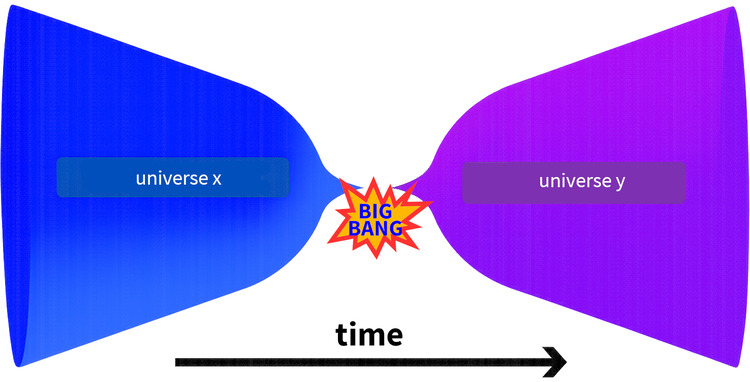
The oscillating universe model is this: The universe expands for billions of years (like it’s doing now). But if there’s enough matter in the universe, gravity could eventually overcome the outward expansion of the universe and start pulling everything back in. When this happens, the universe starts to collapse back in on itself in a kind of reverse Big Bang – eventually collapsing into a single point in what’s sometimes called a ‘Big Crunch.’ Then, somehow, that collapse triggers another expansion – a new Big Bang – and the whole cycle starts again. So, according to this model, we are in the midst of an eternal cycle of expansion, collapse, and repeat.
This oscillating universe model is one of many possible cosmologies. But if it’s right, then maybe the universe doesn’t have a beginning at all. And if the universe doesn’t have a beginning then premise 2 of the Kalām argument is false. The universe didn’t “begin to exist”, it’s always existed for eternity.
Aquinas’ 1st Way – the argument from motion
“The first and more manifest way is the argument from motion. It is certain, and evident to our senses, that in the world some things are in motion. Now whatever is in motion is put in motion by another, for nothing can be in motion except it is in potentiality to that towards which it is in motion; whereas a thing moves inasmuch as it is in act. For motion is nothing else than the reduction of something from potentiality to actuality. But nothing can be reduced from potentiality to actuality, except by something in a state of actuality. Thus that which is actually hot, as fire, makes wood, which is potentially hot, to be actually hot, and thereby moves and changes it. Now it is not possible that the same thing should be at once in actuality and potentiality in the same respect, but only in different respects. For what is actually hot cannot simultaneously be potentially hot; but it is simultaneously potentially cold. It is therefore impossible that in the same respect and in the same way a thing should be both mover and moved, i.e. that it should move itself. Therefore, whatever is in motion must be put in motion by another. If that by which it is put in motion be itself put in motion, then this also must needs be put in motion by another, and that by another again. But this cannot go on to infinity, because then there would be no first mover, and, consequently, no other mover; seeing that subsequent movers move only inasmuch as they are put in motion by the first mover; as the staff moves only because it is put in motion by the hand. Therefore it is necessary to arrive at a first mover, put in motion by no other; and this everyone understands to be God.”
– Aquinas, Summa Theologica
St. Thomas Aquinas‘ 1st way is the cosmological argument from motion.
Here, ‘motion’ doesn’t just mean moving physical location, like a ball rolling along the ground, but it also includes any kind of change – like wood becoming hot when set on fire. Before the fire, the wood is potentially hot. After the fire, it’s actually hot. So “motion” means the transition from potential to actual.
So with this in mind, Aquinas 1st way can be summarised like this:
- Things in the world are in motion
- Whatever is in motion must be moved by something else
- If A is moved by B, and B is moved by C, and so on…
- Then if the chain goes on forever, there’s no first mover
- But if there’s no first mover, there’d be no motion at all
- But we know motion exists
- So there must be a first mover
- And this first mover is God
At first glance, this might not sound too different to the Kalām argument. For example, the wood is heated by the flame, the flame is created by me striking a match, and this sequence of motion and movers stretches back in time to a first mover. But this isn’t how Aquinas intends the argument. The sequence doesn’t just stretch backwards horizontally in time, but also vertically in the sense of a hierarchical chain happening in the present moment. For example:
- The wood is hot
- Because of the fire
- Which burns because of oxygen and chemical reactions
- Which rely on physical laws and particles, etc.
All of these things are happening at the same time. They’re part of a vertical chain – not a horizontal one stretching backward in time. And Aquinas argues that this vertical chain can’t go on forever. You need something at the top – something that causes change but isn’t changed itself. Something that’s pure actuality, with no potential left. In other words: an unmoved mover – God.
So, unlike the Kalām argument, Aquinas’ 1st way still works even if we live in an eternal, oscillating, universe. Even if time stretched back infinitely into the past, the whole chain of causes still wouldn’t explain why anything exists or moves right now. To properly explain motion and change – both horizontally and vertically – we need a present and sustaining cause, not just something that kicked off the process some time in the past. And this being is God.
Aquinas’ 2nd Way – the argument from causation
“The second way is from the nature of the efficient cause. In the world of sense we find there is an order of efficient causes. There is no case known (neither is it, indeed, possible) in which a thing is found to be the efficient cause of itself; for so it would be prior to itself, which is impossible. Now in efficient causes it is not possible to go on to infinity, because in all efficient causes following in order, the first is the cause of the intermediate cause, and the intermediate is the cause of the ultimate cause, whether the intermediate cause be several, or only one. Now to take away the cause is to take away the effect. Therefore, if there be no first cause among efficient causes, there will be no ultimate, nor any intermediate cause. But if in efficient causes it is possible to go on to infinity, there will be no first efficient cause, neither will there be an ultimate effect, nor any intermediate efficient causes; all of which is plainly false. Therefore it is necessary to admit a first efficient cause, to which everyone gives the name of God.”
– Aquinas, Summa Theologica
Aquinas’ 2nd way is basically the same idea as the 1st way, it just uses the idea of cause and effect instead of motion. Here’s the basic argument:
- The world is full of causes and effects
- Nothing can cause itself
- Every cause needs a prior cause
- If this sequence goes on forever, there’s no first cause
- But if there’s no first cause, there’d be no causes at all
- But we know causes exist
- So there must be a first cause
- And this first cause is God
Again, the point is that nothing can cause itself and so there must be a first cause.
This again might sound like the Kalām argument – where causes stretch back in time to a first cause. But like in his 1st way, Aquinas is again focused on a present, sustaining cause – a vertical first cause in the present moment – rather than something that caused the universe a long time ago.
So, back to the fire example:
- The fire causes the wood to be hot right now.
- But the fire only burns because of molecular motion,
- which only works because of physical laws, and so on.

So, again, all these causes are stacked vertically – and Aquinas says that stack can’t go on forever. There has to be something at the base of it. Something that exists on its own, without needing a cause. And that thing is God.
Problem: Is the first cause God?
However, even if you accept that there has to be a first cause or a first mover – does that have to be God?
 Specifically, does this first cause or first mover have to be the kind of God described in religion:
- an all-powerful (omnipotent),
- all-knowing (omniscient),
- all-good (omnibenevolent),
- and personal being?
You could argue that the first cause could be an impersonal being like Aristotle’s prime mover.
Or perhaps this first cause is something else entirely – like some fundamental law of physics, or a brute fact about the universe. Maybe, if you trace the chain of causes far enough, you just hit a point where the laws of reality just are – maybe you reach a foundational level of explanation at which point there is no further reason. For example, science may say that eventually you reach a base-level quantum field or some other bedrock of physical explanation and the story stops there.
Applied to the Kalām argument: We might accept that “everything that begins to exist has a cause,” and that “the universe began to exist.” And because this argument structure is valid, we would also have to accept the conclusion – that “the universe has a cause”. But, even if we accept this conclusion, there is nothing logically inconsistent about rejecting the further inference to “this cause is God” – the omnipotent personal being of religion.
So, you could argue that none of these cosmological arguments necessarily prove God exists. At best, they prove that there’s a first cause or a first mover – but whether that first cause or first move is the God of religion is a separate question that requires further evidence.
Descartes’ cosmological argument
René Descartes‘ cosmological argument is somewhat long-winded compared to the others we’ve looked at so far, but it does provide reasoning why this first cause must be God – omnipotent, omnsicient, and perfect – specifically.
In Meditation III, Descartes goes through a process of elimination to explain his existence:
- I am a thinking thing with the idea of God – what is the cause of my existence?
- Option 1: I am the cause of my own existence.
- Descartes rules this out because if he was the cause of his own existence, he would have made myself perfect. And this makes sense: If you were creating yourself, like a video game character, you’d want to max out the stats: You’d give yourself the maximum amount of power, knowledge, and so on – i.e. you’d make yourself omnipotent and omniscient.
- Option 2: I have always existed.
- Descartes rules this out firstly because he would be aware of this,
- And secondly, this wouldn’t explain his continued existence – again, even if there’s a horizontal series that extends back forever in time, that doesn’t explain what sustains me in existence: The fact that I’m alive now doesn’t cause me to be alive the next moment – i.e. it doesn’t provide the kind of vertical causation Aquinas was talking about.
- Option 3: My parents or some other being is the cause of my existence.
- But, again, your parents or some other being don’t provide that vertical causal explanation. Going back in time, your parents are the cause of your existence in a horizontal sense, but they don’t sustain you in existence from moment to moment.
- Plus, even if your parents were the (horizontal) cause of your physical existence, this just raises the question of what caused them, and then what caused the grandparents, and on and on until we get an infinite regress, which is impossible.
- So, this only leaves one explanation: God.
- Option 1: I am the cause of my own existence.
So Descartes has a few reasons why this ultimate cause must be God specifically.
Firstly, as mentioned, there can’t be an infinite regress of causes. Eventually, you reach a point where something is the cause of itself and – as mentioned – whatever is the cause of its own existence would make itself perfect (omnipotent, omniscient, etc.) i.e. would make itself God.
“Then one may inquire whether this cause owes its origin and its existence to itself, or to some other thing. For if it owes it to itself, it follows, from the reasons I have advanced above, that it must be God; for, having the virtue of being and existing of itself, it must also without doubt have the power of actually possessing all the perfections of which it conceives the idea, that is to say, all those I conceive to be in God. But if it owes its existence to some cause other than itself, we shall ask again, for the same reason, whether this second exists of itself, or through some other, until, by degrees, we arrive finally at an ultimate cause which will be God.”
– Descartes, Meditations on First Philosophy
And secondly, because of the causal adequacy principle from his trademark argument, Descartes says that the cause of an effect must have at least as much “reality” as the effect. And since Descartes has an idea of a perfect, infinite being, the only thing that could’ve caused that idea is something that’s actually perfect and infinite – again, God.
“And the whole force of the argument I have used here to prove the existence of God consists in this, that I recognize that it would not be possible for my nature to be as it is, that is to say, that I should have in me the idea of a God, if God did not really exist;”
– Descartes, Meditations on First Philosophy
Problem: Hume on causation
All the cosmological arguments we’ve looked at so far assume some variation of the causal principle – that everything has a cause:
- This is premise 1 of the Kalām argument, for example, that “whatever begins to exist has a cause”.
- In the 2nd way, Aquinas says every effect has a cause and in the first way that everything that’s in motion must have been put in motion by something else.
- Descartes, in his cosmological argument, says the cause of an effect must have as much reality as the effect (the causal adequacy principle).
But David Hume casts doubt on this causal principle in Enquiry Concerning Human Understanding. Hume’s fork says there’s two and only two ways we can know things:
- As relations of ideas
- or as matters of fact.
You can know something as a relation of ideas if it’s impossible and contradictory to imagine it being false. So, you can know “triangles have 3 sides” as a relation of ideas – a priori – because the idea of a 4-sided triangle isn’t a coherent idea – you can’t imagine it because ‘triangle’ and ‘4-sided’ contradict each other.
Now if we apply this same test to the causal principle – that every effect has a cause – we don’t get the same result: We can imagine an effect without a cause. I can picture a chair springing into existence without a cause – the idea makes sense. Even if we never experience this happening in reality, the idea at least makes sense – it’s conceivable and imaginable in a way that a 4-sided triangle isn’t. This shows that the causal principle is not a relation of ideas.
So the second way we can know something is as a matter of fact, from experience. But Hume says we never actually experience causation. We never experience A cause B, we only ever experience B follow A:
“But when one particular species of event has always, in all instances, been conjoined with another, we make no longer any scruple of foretelling one upon the appearance of the other, and of employing that reasoning, which can alone assure us of any matter of fact or existence. We then call the one object, Cause; the other, Effect. We suppose that there is some connexion between them; some power in the one, by which it infallibly produces the other, and operates with the greatest certainty and strongest necessity.
It appears, then, that this idea of a necessary connexion among events arises from a number of similar instances which occur of the constant conjunction of these events; nor can that idea ever be suggested by any one of these instances, surveyed in all possible lights and positions. But there is nothing in a number of instances, different from every single instance, which is supposed to be exactly similar; except only, that after a repetition of similar instances, the mind is carried by habit, upon the appearance of one event, to expect its usual attendant, and to believe that it will exist…. The first time a man saw the communication of motion by impulse, as by the shock of two billiard balls, he could not pronounce that the one event was connected: but only that it was conjoined with the other. After he has observed several instances of this nature, he then pronounces them to be connected. What alteration has happened to give rise to this new idea of connexion? Nothing but that he now feels these events to be connected in his imagination, and can readily foretell the existence of one from the appearance of the other. When we say, therefore, that one object is connected with another, we mean only that they have acquired a connexion in our thought,”– Hume, Enquiry Concerning Human Understanding
 So, Hume’s point with the billiard balls here is that we never see one ball cause the other to move, we only ever see the “constant conjunction” of one ball moving and then the other ball moving. But even if we see this happen 1000 times, this doesn’t justify a “necessary connexion” between the two events – it might be different the 1001st time.
Applied to cosmological arguments, Hume’s argument here challenges the key premise that “everything has a cause”. The belief that everything has a cause is just a custom, he says, something the mind imagines and projects on to what it has experienced after seeing B follow A enough times. But how can we know this belief will always hold – that B will always follow A? There’s nothing logically necessary about it and so it could simply be false. Later on Hume says:
“we have no argument to convince us that objects, which have… been frequently conjoined, will likewise, in other instances, be conjoined in the same manner… nothing leads us to this inference but custom or a certain instinct of our nature; which it is indeed difficult to resist, but which, like other instincts, may be fallacious and deceitful.”
– Hume, Enquiry Concerning Human Understanding
And this doubt becomes even stronger when talking about the creation of the universe: We only learn to expect effects to follow causes from within the universe – through repeated experience of one event consistently following another. But then with cosmological arguments we’re applying this principle to something completely different and outside the universe, i.e. the creation of the universe. But as Hume points out:
“It is only after a long course of uniform experiments … that we attain a firm reliance and security with regard to a particular event.”
– Hume, Enquiry Concerning Human Understanding
So even if everything we’ve observed within the universe has a cause, that doesn’t justify applying the same principle beyond the universe itself. The creation of the universe is a unique case – we don’t have multiple examples of universes beginning to exist. And without that repetition – without a larger sample size of B following A – Hume would say the inference to a cause isn’t justified.
So Hume’s point here is that it casts doubt on a key premise of all the cosmological arguments we’ve covered – the causal principle, that everything has a cause. Applied to the Kalām argument, for example, Hume would question the first premise that “whatever begins to exist has a cause” – this isn’t something that’s necessarily true, as a relation of ideas, nor is it something that can be proved by experience as a matter of fact. And the same doubt affects Aquinas’ First and Second Ways, as well as Descartes’ version of the cosmological argument because they all rely on the idea that causation is necessary or self-evident. And if this premise is false, the inference to God’s existence fails.
Aquinas’ 3rd Way – the argument from contingency
“The third way is taken from possibility and necessity, and runs thus. We find in nature things that are possible to be and not to be, since they are found to be generated, and to corrupt, and consequently, they are possible to be and not to be. But it is impossible for these always to exist, for that which is possible not to be at some time is not. Therefore, if everything is possible not to be, then at one time there could have been nothing in existence. Now if this were true, even now there would be nothing in existence, because that which does not exist only begins to exist by something already existing. Therefore, if at one time nothing was in existence, it would have been impossible for anything to have begun to exist; and thus even now nothing would be in existence-which is absurd. Therefore, not all beings are merely possible, but there must exist something the existence of which is necessary. But every necessary thing either has its necessity caused by another, or not. Now it is impossible to go on to infinity in necessary things which have their necessity caused by another, as has been already proved in regard to efficient causes. Therefore we cannot but postulate the existence of some being having of itself its own necessity, and not receiving it from another, but rather causing in others their necessity. This all men speak of as God.”
– Aquinas, Summa Theologica
Aquinas’ 3rd way is different kind of cosmological argument – a cosmological argument from contingency.
So, where the other arguments above all assume some variation of the causal principle – they rely on the idea of cause and effect – these versions instead use the ideas of necessity and contingency:
| Contingent | Necessary |
| Exists but might not have existed | Must exist, impossible not to exist |
| E.g. this website exists but if I didn’t decide to make it then it wouldn’t exist | E.g. God is said to exist necessarily, His existence is not caused by or dependent on anything else |
In other words, if something exists contingently, then it might not have existed. You, for example, exist contingently because if your parents never met then you wouldn’t have been born – your existence is contingent on them.
If you look around the world, basically everything exists contingently – it might not have existed:
- If the seed wasn’t planted, the plant wouldn’t exist
- If the Sun hadn’t formed, planet Earth wouldn’t have formed either
- If the Big Bang didn’t happen, the universe wouldn’t exist
Anyway with this concept of contingency in mind, Aquinas’ 3rd way can be summarised like this:
- Things in the world (like you, your parents, the world, the solar system, etc.) exist contingently — they could have not existed.
- Whatever exists contingently did not exist at some point
- If everything were contingent, then at some time, nothing would have existed
- But if nothing ever existed, then nothing could have come into existence
- But since things did begin to exist, there was never nothing in existence
- Therefore, there must be something that does not exist contingently, but that exists necessarily
- This necessary being is God.
So unlike contingently existing things – things that might not have existed – a necessarily existing being is one that can’t not exist – that must exist and whose existence is not dependent on anything else. And this necessary being is needed to explain why there is anything at all, rather than nothing. If everything were the kind of thing that might not have existed and at some point did not exist, then it’s hard to see how anything would exist now. So, Aquinas argues, there must be at least one thing that exists necessarily in order to explain the existence of all the contingent things we see around us. And this necessary being, he says, is God.
Problem: An infinite series (again)?
Perhaps the weakest premise of Aquinas’ 3rd way above is that “if everything were contingent, then at some time, nothing would have existed”.
One might argue, a bit like with the oscillating universe example above, that there could be a never-ending chain of contingent beings stretching back to infinity, where each contingent thing is explained by a prior contingent thing. And if this infinite sequence is possible, then everything could be contingent without there ever being a time when nothing existed.
So this challenges Aquinas’ argument because it means that a contingent universe could be eternal in some sense without needing a necessarily existing being to stop the regress.
Potential response:
However, although the concept of infinity might make sense in an abstract sense, the idea of an actual infinity existing in reality is paradoxical and therefore impossible. One way to illustrate this is with a famous thought experiment called Hilbert’s Hotel:
- Hilbert’s Hotel is a hotel with infinitely many rooms, all of which are occupied.
- But despite being fully booked, the hotel can still accommodate new guests by shifting everyone to a different room (for example, moving the guest in room 1 to room 2, room 2 to room 3, and so on), thus freeing up room 1 for the newcomer.
- So, the hotel is both fully occupied – every room has a guest staying in it – but also able to take on more guests, which is contradictory.
So actual infinities appear to lead to contradictions, which are impossible, which suggests that an actual infinity cannot exist in the real, physical world.
And so, returning to cosmological arguments, the idea of an infinite regress of contingent beings is contentious because it implies the existence of an actual infinity. This suggests that Aquinas is justified in claiming that there must be a necessary being that grounds the existence of contingent things and prevents this infinite regress.
Leibniz’s cosmological argument – the principle of sufficient reason
Gottfried Leibniz‘s cosmological argument begins with the principle of sufficient reason. In Leibniz’s words, the principle of sufficient reason says:
“there can be no fact real or existing, no statement true, unless there be a sufficient reason, why it should be so and not otherwise, although these reasons usually cannot be known by us.”
– Leibniz, Monadology
In other words, the principle of sufficient reason is that there is always a reason why something is the case.
For example, the reason that water freezes at 0°C (under normal atmospheric pressure) is because of the physical properties of water molecules. Or, the reason that London is the capital of England is because it was the economic and political centre of the country in Roman times and became officially recognised as the capital in the 12th Century.
So there is always an explanation or reason why things are the way they are – even if we don’t or can’t know what that reason is. In physics, for example, gravity seems to be much weaker than the nuclear forces – and no one really knows why. But the principle of sufficient reason still holds here: There will ultimately be a reason why gravity is weaker than the nuclear forces, it’s just that that reason hasn’t yet been discovered or maybe will never be discovered.
So that’s the principle of sufficient reason – that every fact has a complete explanation why it is the case and not otherwise. And Leibniz then applies this principle to the two different types of truth:
- Necessary truths, or what Leibniz calls “truths of reasoning”
- and contingent truths, what Leibniz calls “truths of fact”
The sufficient reason for necessary truths – like noncontradiction or “2+2=4” – is revealed by analysis: You can break necessary truths down into fundamental logical principles that are self-evident. Once you’ve reached that point there’s no further explanation needed. To understand what 2+2=4 means is to understand that it must be true.
But the sufficient reason of contingent truths – like that water freezes at 0°C – isn’t reached so easily. You could explain this fact by saying it’s because of the physical properties of water molecules. But this just raises the further questions of why the water molecules are arranged that way, and why the laws of physics are the way they are. Any explanation we give for contingent truths will just be another contingent truth, which will itself require an explanation.
So explaining contingent truths leads to the same infinite regress problem: Your (contingent) existence is explained by your parents, but that isn’t a sufficient reason because you’d then need to explain your parents’ (contingent) existence, and so on and so on for infinity. You can never give a sufficient reason for contingent truths in this way.
And so to break this infinite regress and provide sufficient reason for contingent truths, we need to appeal to something that exists necessarily: God. Leibniz says:
“as all this detail again involves other prior or more detailed contingent things, each of which still needs a similar analysis to yield its reason, we are no further forward: and the sufficient or final reason must be outside of the sequence or series of particular contingent things, however infinite this series may be. Thus the final reason of things must be in a necessary substance,… and this substance we call God.”
– Leibniz, Monadology
So, Leibniz’s cosmological argument can be summarised like this:
- The principle of sufficient reason: Every true fact has a reason why it is true
- The sufficient reason for necessary truths (e.g. “3+3=6”) is revealed by analysis
- But we cannot provide sufficient reason for contingent truths (e.g. “water boils at
100°C” or “the universe exists”) without referring to other contingent truths, which
also need a sufficient reason - An infinite sequence of contingent truths would not provide sufficient reason
- So, in order to provide sufficient reason for contingent truths, we need to appeal to a
necessary substance: God.
Problem: The fallacy of composition?
The fallacy of composition is the – often invalid – inference from parts of something to the whole. For example:
- The book is made up of sheets of paper,
- And sheets of paper are thin.
- Therefore the book is thin.
But this doesn’t always follow: Just because all the parts of the book have the property of being thin, it doesn’t follow that the book itself is has this property. War and Peace by Tolstoy, for example, is such a long novel, with so many pages, that the book would not be described as thin. So you can’t always generalise from all the parts of something to the whole.
Bertrand Russell argued that cosmological arguments make the same mistake: Just because everything within the universe has a cause or an explanation, it doesn’t necessarily follow that the universe itself has a cause or an explanation. Instead, in his debate with Frederick Copleston, Russell says:
“I should say that the universe is just there, and that’s all.”
– Bertrand Russell, 1948 BBC Radio Debate with Frederick Copleston
Potential response:
However, the fallacy of composition is an informal fallacy. This means that whether or not the inference is invalid depends on the context and content – the specifics of the example. For example:
- All the parts of the table are made from wood,
- Therefore the table itself is made from wood.
This does follow: If all the parts of the table are made from wood, then it’s not possible for the table itself to be made from something else.
And Copleston makes this point in the debate with Russell:
“Now, secondly, the world is simply the real or imagined totality or aggregate of individual objects, none of which contain in themselves alone the reason for their existence. There isn’t any world distinct from the objects which form it, any more than the human race is something apart from the members. Therefore, I should say, since objects or events exist, and since no object of experience contains within itself reason of its existence, this reason, the totality of objects, must have a reason external to itself… If you add up chocolates you get chocolates after all and not a sheep. If you add up chocolates to infinity, you presumably get an infinite number of chocolates. So if you add up contingent beings to infinity, you still get contingent beings, not a necessary being. An infinite series of contingent beings will be, to my way of thinking, as unable to cause itself as one contingent being.”
– Frederick Copleston, 1948 BBC Radio Debate with Bertrand Russell
So, in response to the objection that cosmological arguments commit the fallacy of composition, one could argue that:
- Everything within the universe exists contingently,
- The universe itself is nothing more than the totality of these contingent things,
- And so the universe itself exists contingently.
And so, going by the principle of sufficient reason, we still require an explanation of the universe: Why something rather than nothing? Defenders of cosmological arguments say that the only way we can explain the existence of our contingent universe is with a necessary being – i.e. God.
Problem: The impossibility of a necessary being
Cosmological arguments from contingency say that the universe is made up of contingent beings – things that could have not existed – and so there must be something that exists necessarily to explain why anything exists at all. But some philosophers, like David Hume, question whether a necessary being is even a possible thing:
“Nothing, that is distinctly conceivable, implies a contradiction. Whatever we conceive as existent, we can also conceive as non-existent. There is no Being, therefore, whose non-existence implies a contradiction… It is pretended that [God] is a necessarily existent Being; and this necessity of his existence is attempted to be explained by asserting, that, if we knew his whole essence or nature, we should perceive it to be as impossible for him not to exist as for twice two not to be four. But it is evident, that this can never happen, while our faculties remain the same as at present. It will still be possible for us, at any time, to conceive the non-existence of what we formerly conceived to exist… The words, therefore, necessary existence, have no meaning; or, which is the same thing, none that is consistent.”
– Hume, Dialogues Concerning Natural Religion
In other words, Hume says that if God did exist necessarily, then it would be contradictory and therefore inconceivable to imagine God not existing. According to Hume, if God did exist necessarily, then trying to imagine a world where God does not exist would be as impossible as imagining a 4-sided triangle – the idea wouldn’t make sense because the terms would contradict each other. But since “God does not exist” is conceivable – it’s not obviously self-contradictory – Hume says that God can’t exist necessarily.
Bertrand Russell made a similar point in his debate with Frederick Copleston, but uses slightly different terminology:
“The word “necessary” I should maintain, can only be applied significantly to propositions. And, in fact, only to such as are analytic – that is to say – such as it is self-contradictory to deny. I could only admit a necessary being if there were a being whose existence it is self-contradictory to deny.”
– Bertrand Russell, 1948 BBC Radio Debate with Frederick Copleston
Like Hume, Russell is saying that if God exists as a necessary being, then “God exists” would be an analytic truth – something that’s true by definition, like “all bachelors are unmarried” or “all triangles have 3 sides”. And so, “God does not exist” would be a contradiction.
However, “God does not exist” is not obviously contradictory – it’s not like a 4-sided triangle or a married bachelor. And so, according to Russell, “God exists” can’t be an analytic truth and so God can’t exist as a necessary being.
Potential response:
However, this objection potentially conflates two meanings of ‘necessary’:
- So, the first sense of ‘necessary’ – the one that Russell is using here – is in the sense of a necessary truth. And necessary truths are, for all intents and purposes, the same as analytic truths – necessary truths lead to contradictions when denied – which is why Russell equates necessary with analytic truth here.
- Example: “triangles have 3 sides” is a necessary truth – it leads to a contradiction when denied.
- But in the context of cosmological arguments, ‘necessary’ is meant in the sense of the property of necessary existence – the property of not being contingent upon something else to exist.
- Example: “God exists necessarily” is a description of the properties of God (if He exists)
So, when contingency arguments say that God is a necessary being, they don’t mean that “God exists” is a necessary or analytic truth. Instead, they’re saying that God’s nature, if He exists, is to exist necessarily – to not depend on anything else. Even an atheist could accept this definition of God as a necessarily existing being but deny that such a being actually exists.
In other words, Russell and Hume might be right to say that “a necessary being does not exist” is not logically contradictory. But this doesn’t settle whether a necessary being actually does exist. It just means that “a necessary being exists” isn’t true by definition.
References/further reading:
- The Kalam Cosmological Argument by William Lane Craig
- Incoherence of the Philosophers by Abu Hamid al-Ghazali
- Summa Theologica by Thomas Aquinas
- Meditations on First Philosophy by Rene Descartes
- Monadology by Gottfried Wilhelm Leibniz
- Dialogues Concerning Natural Religion by David Hume
- Enquiry Concerning Human Understanding by David Hume
- 1948 Russell-Copleston radio debate
- Stanford page on cosmological arguments