
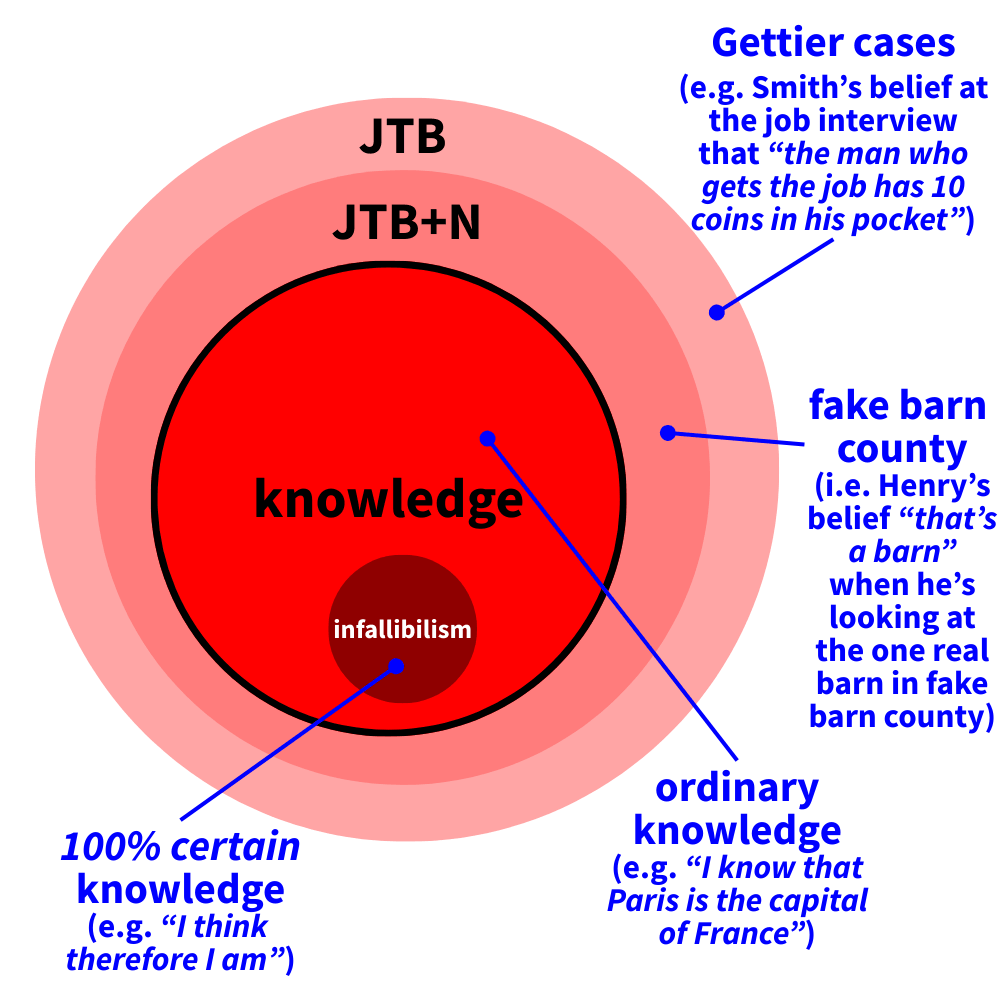
The venn diagram below illustrates how the definitions of knowledge debate works – we’re trying to provide the necessary and sufficient conditions for the word ‘knowledge’ (the red circle in the middle):
The classic definition of knowledge was justified true belief, which originated in Plato’s dialogue Theaetetus:
“SOCRATES: Well, are you happy with it? Will you adopt the suggestion that knowledge is true belief accompanied by a [justification]?
THEAETETUS: Absolutely.”
– Plato, Theaetetus
For ‘justified true belief’ to be the correct definition of ‘knowledge’, it needs to provide the necessary and sufficient conditions. For more detail on what this means, see this post. But, in short, this basically just means:
- Everything that is knowledge will be a justified true belief
- and everything that is a justified true belief will be knowledge.
To put it in terms of venn diagrams, it would look like two circles that overlap perfectly. The ‘knowledge’ circle would be the same as the ‘justified true belief’ circle.
Gettier problems
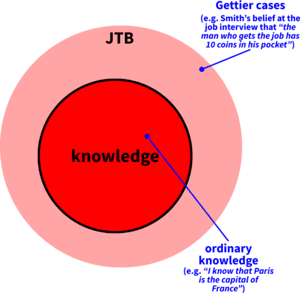 But the ‘justified true belief’ circle and the ‘knowledge’ circle don’t overlap perfectly, as Gettier problems (from Edmund Gettier’s 1963 paper Is Justified True Belief Knowledge?) are supposed to show.
Gettier problems are weird scenarios where someone has a justified true belief that isn’t knowledge.
And, if you can have a justified true belief that isn’t knowledge, then the ‘justified true belief’ definition is too broad – it’s not sufficient for knowledge.
The first Gettier scenario is something like this:
- Smith and Jones are interviewing for a job
- Smith hears the interviewer say “I’m going to give Jones the job”
- And Smith sees Jones pull out 10 coins from his pocket
- So, based on 2 & 3, Smith can justify the belief that “the man who will get the job has 10 coins in his pocket”
- But, somehow, the interviewer gives Smith the job
- Then Smith looks in his pocket and, by pure coincidence, realises he also had 10 coins in his pocket
- So his belief “the man who will get the job has 10 coins in his pocket” was true and justified, i.e. it met all 3 conditions of the justified true belief definition.
But, despite being a justified true belief, Smith’s belief “the man who will get the job has 10 coins in his pocket” wasn’t really knowledge because the fact that it turned out to be true was just lucky – Smith thought Jones would get the job, and it was pure coincidence that Smith himself had 10 coins in his pocket.
The point is: Just because you have a justified true belief, that doesn’t guarantee you have knowledge.
False lemmas
In the Gettier problem above, Smith forms the true belief that “the man who will get the job has 10 coins in his pocket” from the false belief “Jones will get the job”. This is a false lemma.
A false lemma is basically a wrong stepping-stone in an argument.
So, to avoid Gettier problems, people added an extra condition to the justified true belief definition: ‘no false lemmas’. So, this new definition says ‘knowledge’ is ‘justified true belief that is not derived from a false lemma’.
Adding this new no false lemmas condition narrows the definition of knowledge and successfully rules out Gettier cases – so it’s an improvement.
But, in Discrimination and Perceptual Knowledge, Alvin Goldman described a thought experiment – Fake Barn County – where someone has a justified true belief that isn’t derived from a false lemma, but isn’t knowledge either:
- Henry is driving through ‘Fake Barn County’ – a county where people create structures that look exactly like barns from the road but are not barns
- Henry does not know that most barns in this county are fake
- So when he looks at these fake barns, he forms the false belief “that’s a barn”
- But there is one real barn in Fake Barn County
- And when Henry looks at the one real barn, he forms the true belief “that’s a barn”
- His belief is justified because he is looking directly at what appears to be a barn
- His belief is also true because he’s looking at the real barn
- And his belief is not based on any false lemma
- So Henry has a justified true belief that is not derived from a false lemma that “that’s a barn”.
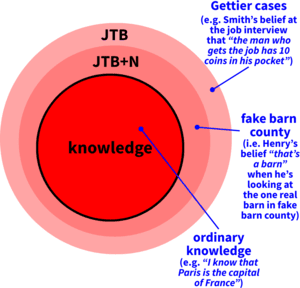 But, like in the Gettier problem above, we don’t want to say Henry’s belief here counts as knowledge. Because, like in the Gettier case, the fact that Henry’s belief is true in this one instance is just lucky because he could easily have been looking at one of the many fake barns instead and he would have formed the exact same belief.
So, while this no false lemmas definition is closer to knowledge than justified true belief, these scenarios are supposed to show that this definition is not sufficient either.
Again: Just because you have a justified true belief that is not based on a false lemma, that doesn’t guarantee you have knowledge.
Certainty
One way to try to salvage the justified true belief definition of knowledge is to insist on certainty.
We might say, as Descartes does at the beginning of Meditations, that for something to count as ‘knowledge’, the justification must make it impossible to doubt. This definition of knowledge is known as infallibilism.
Infallibilism successfully rules out both Gettier problems and Fake Barn County scenarios:
- For example, in the job interview scenario, Smith might have been hallucinating when he heard the interviewer say he was going to give Jones the job. Or, perhaps, Smith could be in bed dreaming that he’s at the job interview and in reality the whole thing never happened.
- As for Fake Barn County, Henry could be dreaming or hallucinating too. It’s possible that his perceptions are completely off track and so there are possible reasons to doubt his belief “that’s a barn”.
So, at first glance, this infallibilist approach to knowledge seems successful. Everything that fits this definition will be knowledge – it is a sufficient definition.
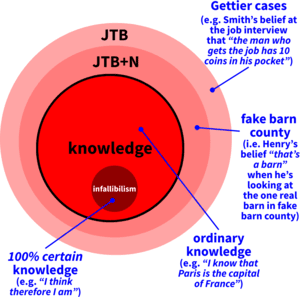 But where justified true belief and no false lemmas were too broad in defining knowledge – they wrongly count Gettier problems and Fake Barn County as knowledge when they aren’t – infallibilism is too narrow because it basically rules out everything as knowledge.
For example, it’s possible to doubt your belief “Paris is the capital of France”. You could be misremembering, you could have been lied to, your entire life could be a deception created by an evil demon, and so on.
Even if these scenarios don’t seem particularly likely, they are possible, and so infallibilism says you don’t know “Paris is the capital of France” or even “2+2=4” because you can always come up with possible reasons why those beliefs might be wrong. But this seems silly. We do know “Paris is the capital of France” and “2+2=4” and all sorts of things.
So this suggests that while the impossibility of doubt may be sufficient for knowledge, it is not necessary.
for a deeper dive on definitions of knowledge, see this page