
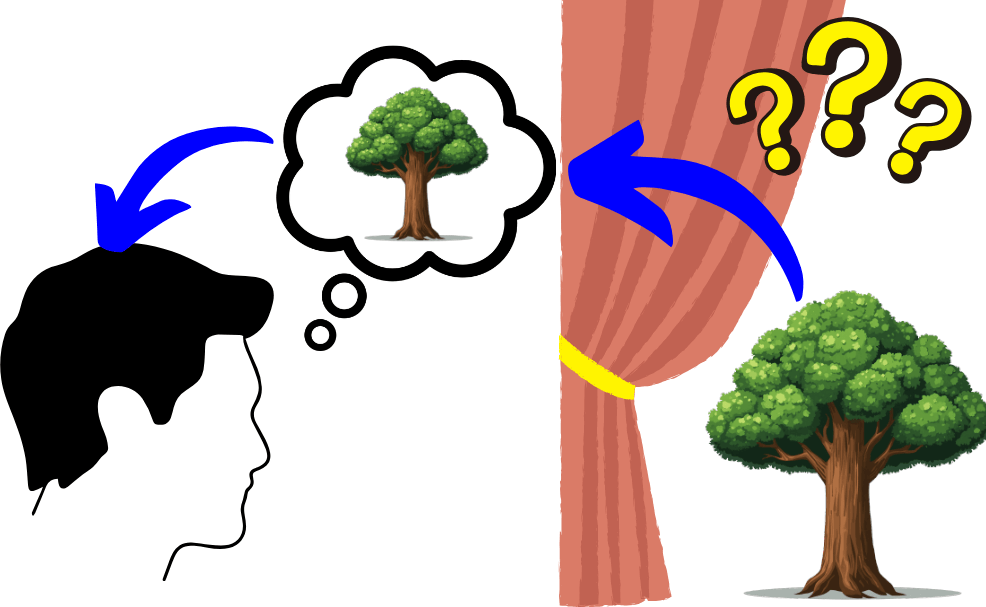
The veil of perception is the idea that we do not perceive the external world directly. Instead, we are only ever aware of internal mental representations – sometimes called sense-data, ideas, perceptions, or experiences – and these stand between us and the world itself.
In other words, we never see the world directly. We only see our experience of the world.
And that experience acts like a veil or barrier between the mind and reality.
How the problem arises
The veil of perception problem usually arises from a very simple thought. When you look at a tree, for example, you experience:
- Green and brown colours
- A certain shape
- A certain texture
But what are you directly aware of? Are you directly aware of the tree itself? Or are you directly aware of your visual experience of the tree?
Consider, for example:
- Dreams
- Hallucinations
- Optical illusions
If you dream that you are at work, or being chased by a monster, or flying over mountains, you are having rich visual and sensory experiences. But you’re not actually at work, there’s no monster in reality, and humans can’t fly so that can’t be happening in the real world. However, while you are dreaming, these experiences feel completely real. You see colours, hear voices, and feel emotions, all with the same vividness as waking life. From the inside, the dream may be subjectively indistinguishable from genuine perception – you don’t realise that you’re dreaming. But when you wake up, you realise that what you were aware of was not the external world itself, but an internally generated experience.
Or, if you have a fever… and hallucinate a pink elephant, you have a particular visual experience. Yet there is no pink elephant in the external world. But again, your experience might be subjectively indistinguishable from a genuine perception.
This suggests that what you are directly aware of – in both actual perception vs. hallucinations or dreams – is a product of your own mind, something subjective, and not the actual, objective, world.
If that’s right, then even in normal perception, you are not directly aware of external objects. You are aware of internal representations. And that is the veil of perception.
The core argument
The reasoning can be summarised this:
- In hallucinations and dreams, we are directly aware of mental experiences, not external objects.
- Hallucinations and dreams can be subjectively indistinguishable from genuine perceptions.
- Therefore, what we are directly aware of in both cases must be the same kind of thing.
- So even in normal perception, we are directly aware of mental experiences – not the external world itself.
If this is correct, then the external world is only ever known indirectly. We are trapped behind a veil of perception.
Why this is a problem
The veil of perception creates a serious epistemological worry. If we only ever have access to our own internal experiences:
- How can we know there is an external world at all?
- How can we know our experiences resemble reality?
- How can we rule out radical sceptical scenarios (e.g. being a brain in a vat)?
If all we ever see are our own mental states, then we never get to step outside them and compare them with reality. And so the world could, in principle, be completely different from how it appears – and we would never know the difference. This leads to scepticism.
Responses to the Veil of Perception
Philosophers have responded to the veil of perception in different ways.
Direct Realism
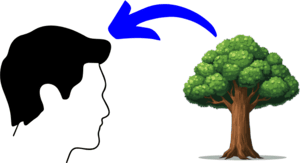
Direct realism denies that there is a veil in the first place.
 According to direct realists:
- In normal perception, we are directly aware of mind-independent objects.
- The tree itself is what we perceive – not a mental representation of it.
Illusions and hallucinations are treated as special or abnormal cases, not as revealing the true structure of perception.
Direct realists argue that the veil theory makes perception far more mysterious than it needs to be. In everyday life, it seems obvious that what we see are trees, tables, chairs, etc. – not inner mental objects.
However, critics argue that direct realism struggles to explain hallucinations convincingly.
Indirect Realism
Indirect realism (sometimes called representational realism) accepts the veil.
 According to this view:
- We are directly aware of mental representations.
- These representations are caused by external objects.
- We perceive the world indirectly, through these representations.
This view explains hallucinations easily – they are just cases where the representation occurs without the object.
However, indirect realism is basically the reason the veil of perception problem exists in the first place. If we only experience representations or sense-data, how can we justify belief in an external world beyond them?
For examples of how indirect realists have tried to respond to this problem, see this page.
Idealism
Idealism denies the veil, but for completely different reasons to direct realism.
 Rather than saying we perceive representations of a physical world, idealists argue that reality itself is fundamentally mental.
For example, George Berkeley argued that objects are just collections of ideas perceived by minds. There is no mind-independent material substance standing behind experience. “To be is to be perceived”, he says.
On this view, there is no veil – because there is nothing ‘behind’ experience to be veiled. Experience is reality.
However, many find idealism counterintuitive because it denies the existence of a mind-independent physical world.
Why the Veil of Perception Matters
The veil of perception is important because it connects to many central philosophical issues:
- The problem of scepticism.
- The nature of perception.
- The relationship between mind and world.
What makes the veil of perception so powerful is how intuitive and difficult to reject it is:
- We are immediately aware of our experiences.
- We are not immediately aware of external objects.
From that starting point, the veil appears almost unavoidable.
If we accept the veil, we open the door to scepticism about the external world.
But if we reject it, we must explain hallucinations and dreams without appealing to internal objects.
Either way, the problem forces us to confront a deep question: Do we ever actually perceive reality? Or just our own private representation of it?
 The philosophy textbook written in plain English!
- Straightforward explanations of syllabus topics for all 4 modules
- Bullet point summaries at the end of each module
- Exam blueprint for each question type (with example answers)
- Example 25 mark essay plans for every major topic
- Glossary of key terms
