
In modern language, we tend to use the word ‘good’ in two different ways:
1. Moral goodness, like to say someone is a good person.
2. Functional goodness, like saying that a car is good or a school is good.
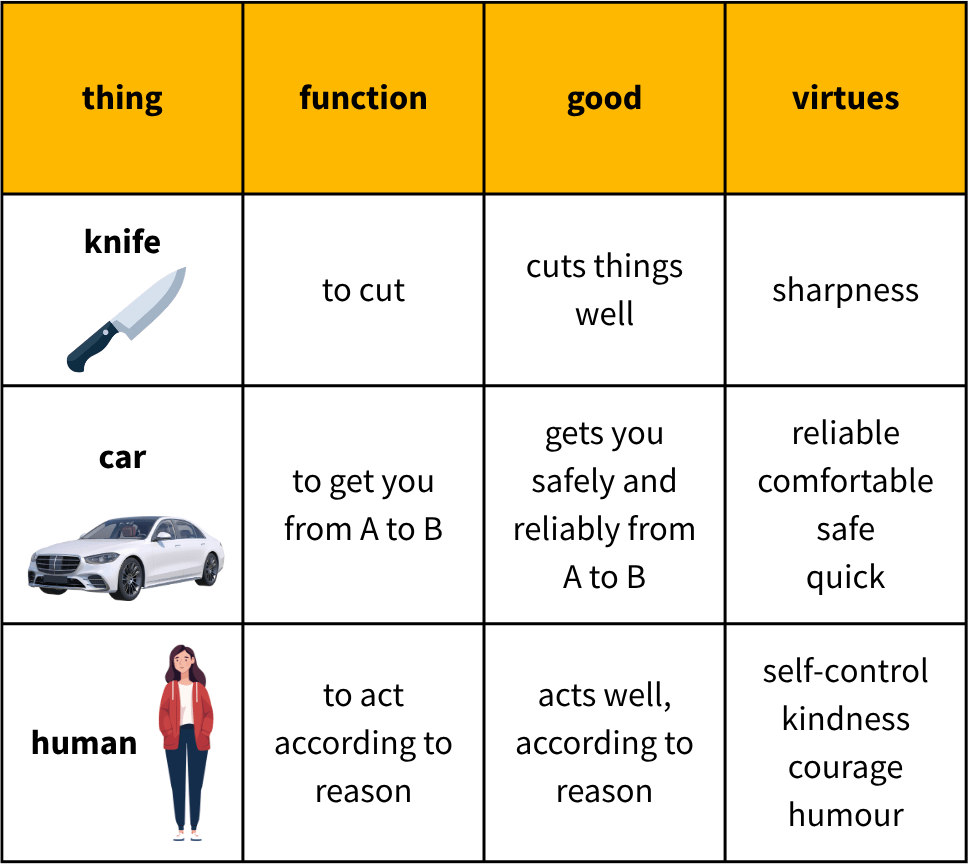
But, for Aristotle, these two concepts are basically the same. His function argument says that what makes a human being ‘good’ is the same thing that makes a car or a school or a knife ‘good’: that it fulfils its function.
For example, the function of a knife is to cut things. And so a ‘good’ knife is one that cuts things well. Sharpness is a virtue of a knife because it enables the knife to perform its function well. In contrast, a ‘bad’ knife is blunt – it isn’t good at cutting things and performing its function.
Or a car: The function of a car is to get you from A to B. If a car is always breaking down, it’s a bad car because it doesn’t perform its function well. Reliability is a virtue of a car – part of what makes a car ‘good’ – because it enables the car to get you from A to B.
And it’s the same for human beings, says Aristotle. The unique function of humans – what differentiates humans from animals, plants, knives, cars, etc. – is the use of reason:
“Just as we can see that eye and hand and foot and every one of our members have some function, should we not assume that in like manner a human being has a function over and above these particular functions? What, then, can this possibly be? Clearly life is a thing shared also by plants, and we are looking for man’s proper function; so we must exclude from our definition the life that consists in nutrition and growth. Next in order would be a sort of sentient life; but this too we see is shared by horses and cattle and animals of all kinds. There remains, then, a practical life of the rational part.”
– Aristotle, Nicomachean Ethics
And, like with these other examples, a good human is one that performs its function, i.e. a good human is one that acts according to reason. Acting according to reason is important here – it’s not just sitting around thinking and reasoning, it’s the use of reason in a practical sense, i.e. making the right moves, saying the right thing, doing what needs to be done to achieve positive results.
“Now, if the function of man is an activity of the soul in accordance with [reason/rationality]; and if we hold that the function of an individual and of a good individual of the same kind – e.g. of a harpist and of a good harpist and so on generally – is generically the same, the latter’s distinctive excellence being attached to the name of the function (because the function of the harpist is to play the harp, but that of the good harpist is to play it well); and if we assume that the function of man is a kind of life, namely, an activity or series of actions of the soul, implying a rational principle; and if the function of a good man is to perform these well and rightly; and if every function is performed well when performed in accordance with its proper excellence: if all this is so, the conclusion is that the good for man is an activity of the soul in accordance with virtue, or if there are more kinds of virtue than one, in accordance with the best and most perfect kind.”
– Aristotle, Nicomachean Ethics
And in the same way that sharpness is a virtue of a knife because it enables the knife to perform its function, virtues are traits that enable humans to act well and perform their function. For example:
- Being hard-working is a virtue because it enables you to stay focused and productively achieve your goals.
- Having self-control is a virtue because it stops your emotions from overriding your logic and making poor decisions.
- Being kind is a virtue because it helps you navigate relationships successfully and live harmoniously within a community.
So, for Aristotle, morality is not about following a list of rules, but about developing the character traits and habits – the virtues – that enable us to perform our function, i.e. to reason and act well as human beings.
And, if you do this over the course of an entire life, you will have a good life, thrive, and achieve ‘eudaimonia’.