
Global scepticism is such a classic of epistemology that it’s made its way into popular culture with films like The Matrix and ideas like the simulation hypothesis. It’s a thread that runs through the history of philosophy from Plato’s cave to Descartes’ evil demon to the modern brain in a vat thought experiment.
Despite differences in detail, the common theme is this: They are all possible scenarios where all your beliefs could be false and you wouldn’t be able to tell the difference. This raises the question of whether we can really know anything at all.
But some philosophers think this sceptical problem only arises if we accept a particular view of knowledge and justification. On an alternative view – epistemic externalism – global scepticism loses its force.
The sceptical argument
Global sceptical arguments begin with a thought experiment like those mentioned above. I’ll use brain in a vat as the example.
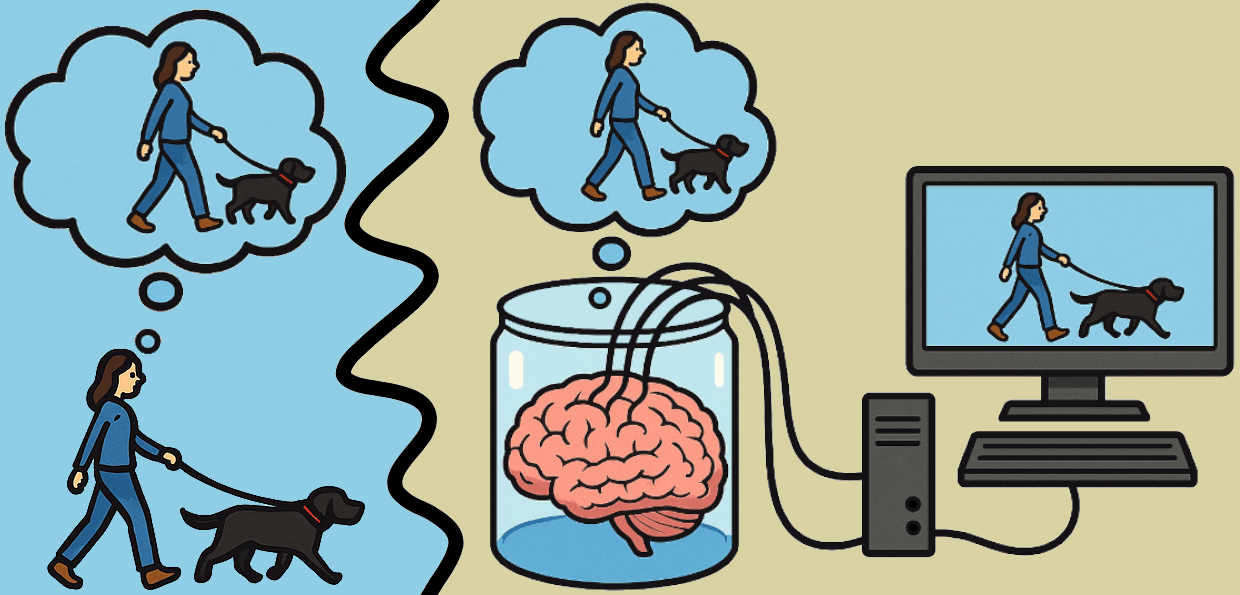
Imagine that you are a brain in a vat, kept alive by scientists and fed electrical signals that perfectly simulate ordinary experience.
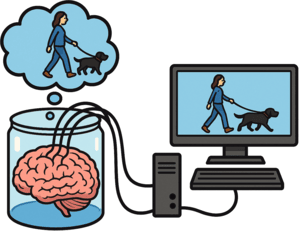 Assuming that experience is just the result of electrical activity in the brain then, from your perspective, your experiences as a brain in a vat would be indistinguishable from normal life. From your perspective, your experience of actually being in the park walking your dog would be indistinguishable from the experience of being a brain in a vat being fed artificial stimuli from a computer to make it feel like you are in the park walking your dog.
(Descartes’ evil demon makes the same point: It’s possible that an omnipotent evil demon is controlling your experiences and thoughts. If this were the case, your experience would be exactly the same as if you really were having those experiences and thoughts. There’s no way to tell the difference between the scenario where you’re in the real world and your beliefs are true vs. the sceptical scenario where all your beliefs are false).
Given the possibility of these scenarios where all your beliefs are false, the sceptic makes an argument like this:
- In order to know some ordinary claim (e.g. “I am walking my dog in the park”), then you need to be able to justify that you’re not a brain in a vat.
- But you can’t justify that you’re not a brain in a vat.
- So, you don’t know these ordinary claims.
(Note: The sceptic isn’t arguing that you really are a brain in a vat. The sceptic’s point is that it’s possible that you could be a brain in a vat and you wouldn’t be able to tell the difference).
This same argument can be applied to any knowledge claim:
- In order to know “I have hands” you need to be able to justify your belief that you’re not actually just a brain in a vat with no hands being tricked by scientists into thinking you have a body and hands.
- In order to know “Paris is the capital of France”, you need to be able to justify that your belief isn’t the result of these maniac scientists feeding you artificial stimuli to make you falsely believe Paris is the capital of France.
- In order to know “grass is green”, you need to be able to justify that your experience of grass isn’t just a crazy illusion from a computer simulation created by these scientists and fed into your brain.
- And so on.
The key idea is that knowledge requires justification, and justification seems to require ruling out relevant alternatives. Since you can’t prove you’re not deceived, the sceptic concludes that you lack knowledge altogether.
These sceptical arguments seem compelling because they rely on an intuitive assumption that, from your own point of view, you should be able to justify your beliefs. But epistemic externalism rejects that assumption.
Epistemic externalism vs. internalism
To see how this sceptical problem might be avoided, we need to distinguish between epistemic internalism and epistemic externalism.
Internalism
According to epistemic internalism, whether a belief counts as knowledge depends entirely on factors that are internally accessible to the subject – things like conscious reasons, evidence, or reflections.
Justified true belief (JTB) is a classic internalist model of knowledge. It says that for something to be knowledge it must be:
- True
- Believed
- Justified
On this view, justification must be something the subject can, in principle, reflect on or articulate. If you can’t internally justify your belief that you’re not a brain in a vat then, according to internalism, you don’t know that you have hands, or that you’re walking your dog, or that Paris is the capital of France.
This makes internalism vulnerable to global scepticism because the whole point of sceptical scenarios like brain in a vat is that there is nothing – from your perspective, internally – that could justify that you’re in the real-world scenario where those beliefs are true over the brain in a vat scenario where those same beliefs are false.
And no justification = no knowledge.
Externalism
However, epistemic externalism rejects the idea that justification must always be internally accessible. According to externalism, what matters is how the belief is formed, but not whether the subject can internally justify or defend it.
An example of an externalist theory of knowledge is reliabilism, which says something like knowledge must be:
- True
- Believed
- Formed by a reliable belief-forming process (i.e. a process that tends to produce true beliefs in the actual world).
Examples of reliable processes include normal vision, memory, and perception under ordinary conditions.
Crucially, on this view, you don’t need to (internally) justify that such belief-forming processes are reliable. If your eyesight is reliable, then it’s reliable – regardless of whether you justify (internally) this reliability.
Reliability is an objective, external fact about how your belief was formed, not something that you have to be able to prove. And this provides a way to resist global scepticism.
How epistemic externalism avoids global scepticism
The sceptical argument depends on the idea that, in order to know something, you must be able to internally justify that you are not deceived. Externalism denies this requirement.
It’s important to point out that this response doesn’t say either way whether you are a brain in a vat. The externalist response doesn’t work by disproving these sceptical scenarios. Instead, it shows that the mere possibility of these sceptical scenarios does not undermine knowledge.
The point is that either:
- You are a brain in a vat, or
- You are not a brain in a vat.
Again, you can’t know which scenario is actually the case – you can’t prove or disprove either. But, assuming you are not a brain in a vat (i.e. scenario 2 is the case), then your senses etc. would be reliable and so you can gain knowledge from them.
So the difference is this:
- JTB (internalist) denies that you can have knowledge in both scenarios 1 and 2 because even if you’re not a brain in a vat (scenario 2 above) and your beliefs are true, they still don’t count as knowledge because you can’t justify them.
- But reliabilism (externalist) allows that you can have knowledge if scenario 2 above is the case because if you’re not a brain in a vat then your beliefs are true and so your senses count as a reliable method.
Obviously, if scenario 1 is true and you are a brain in a vat, then reliabilism and externalism would admit you don’t know, for example, that “I have hands” or anything else. But this is fine because if you are actually a brain in a vat then you really don’t have hands and so that belief would be false! So the problem in this scenario is not about justification, the problem is that the belief isn’t true – that’s why it wouldn’t be knowledge, and that’s correct.
So the crux of the issue is that:
- If internalism is correct then none of your beliefs count as knowledge even if they are true (and so global scepticism wins).
- But if externalism is correct then your beliefs do count as knowledge as long as they are true (and so global scepticism fails).
So even though externalism doesn’t disprove these sceptical scenarios outright, it shows that just because these sceptical scenarios are possible that doesn’t mean we can’t know anything.
 The philosophy textbook written in plain English!