
Ockham’s Razor is an abductive reasoning principle. In other words, it’s a form of reasoning that says something is likely to be true because it provides the best explanation of the observed facts.
More specifically, it says:
Do not multiply entities beyond necessity.
Or, put more simply, Ockham’s Razor says the simplest explanation is most likely to be true (all else being equal). If theory A explains with one thing what theory B explains with two things, then theory A is probably correct because it posits fewer entities and is the simpler theory.
Planetary orbits: an example of Ockham’s Razor
The geocentric vs. heliocentric models of planetary orbits (below) are a good way to illustrate Ockham’s Razor in action.
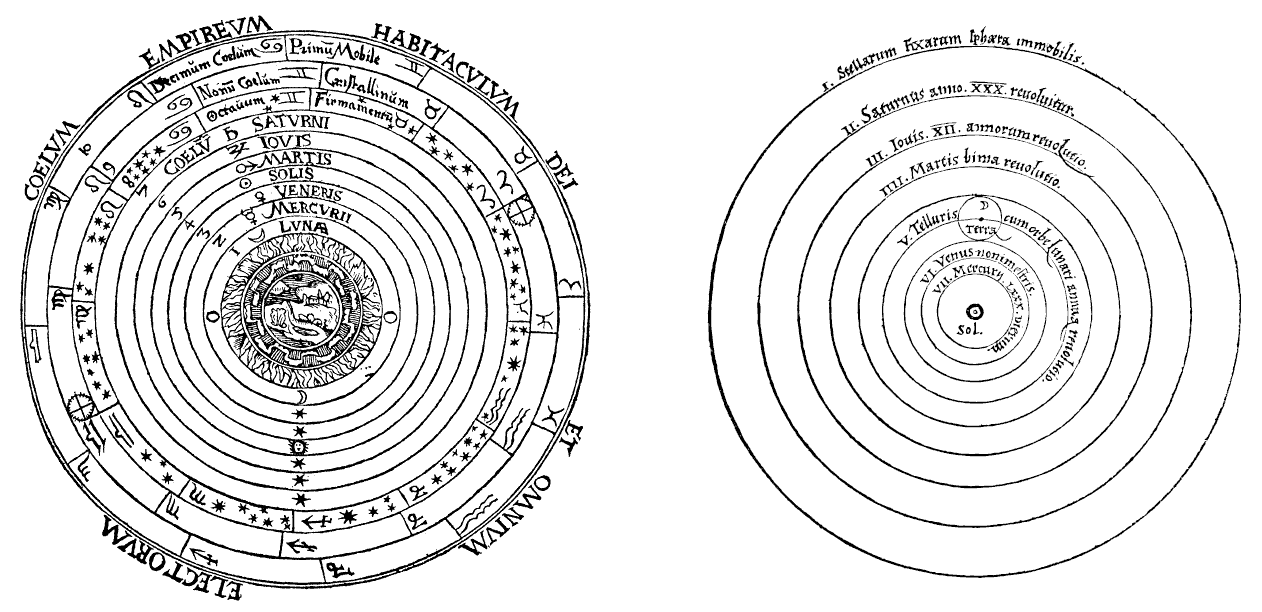
The geocentric model (left) says the Sun and the planets revolve around Earth. This model is able to explain and predict the orbits of planets accurately, but to do so it has to posit a bunch of extra stuff – epicycles (circles upon circles), deferents, and equants – in order to explain why, for example, Mercury (and other planets) sometimes appear to move backward in the sky relative to the background stars.
The heliocentric model (right) says the Earth and other planets revolve around the Sun. And this model is able to explain everything the geocentric model can – it can accurately predict e.g. the orbits of Jupiter and Mercury – but it does so without needing the extra layers of epicycles and adjustments.
So, given that the heliocentric model is simpler than the geocentric model – it posits fewer ‘entities’ – Ockham’s Razor suggests the Earth revolves around the Sun rather than the other way round. And subsequent observations confirmed this to be true. This is Ockham’s Razor in action – that the simpler explanation is usually true (all else being equal).
All else being equal
This point about ‘all else being equal’ is important, though. Just because a theory is simpler, that doesn’t automatically mean it’s true. If a complicated theory makes more accurate predictions than a simpler theory, then the more complicated theory should be preferred because it describes reality more accurately.
So Ockham’s Razor is like a tie-breaker (e.g. goal difference in football when two teams are tied on points at the end of the season) – if you have two theories that are equal in terms of explanatory and predictive power, then the simpler theory is probably true.
