
In a sentence, the zombies argument aims to show that consciousness is non-physical by showing that it is possible to separate physical stuff (e.g. the body and brain) from mental stuff (i.e. consciousness).
But, as always with philosophy, it’s not quite that simple. There are a bunch of technical terms and logical inferences that go into this argument. This post explains how they all go together.
Contents:
The zombies argument
A philosophical zombie is a being that is physically identical to a regular human, but without consciousness – without qualia.
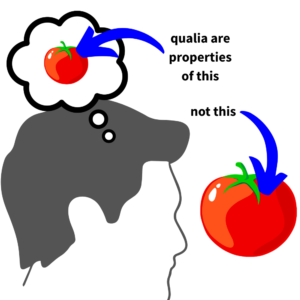 This brings us to the first technical term: Qualia.
You can see this post for a more detailed description but, in short, qualia are properties of our experience.
So, when you look at a red tomato, your visual perception would have red qualia. The qualia is a property of your perception of the tomato, not a property of the tomato itself.
When you stub your toe, you experience pain qualia. Qualia is the subjective ‘what it feels like’ of experience.
But we can imagine someone who, internally, doesn’t have that qualia when they stub their toe. Externally, they’d still:
- Say “ouch!”
- Rub their toe
- If we put them in an MRI scanner, their brain would even light up in the same way as an ordinary human in pain.
The point is, this being – this philosophical zombie – is physically identical to a regular human being in pain. It just doesn’t have inner experience, doesn’t have consciousness, doesn’t have qualia.
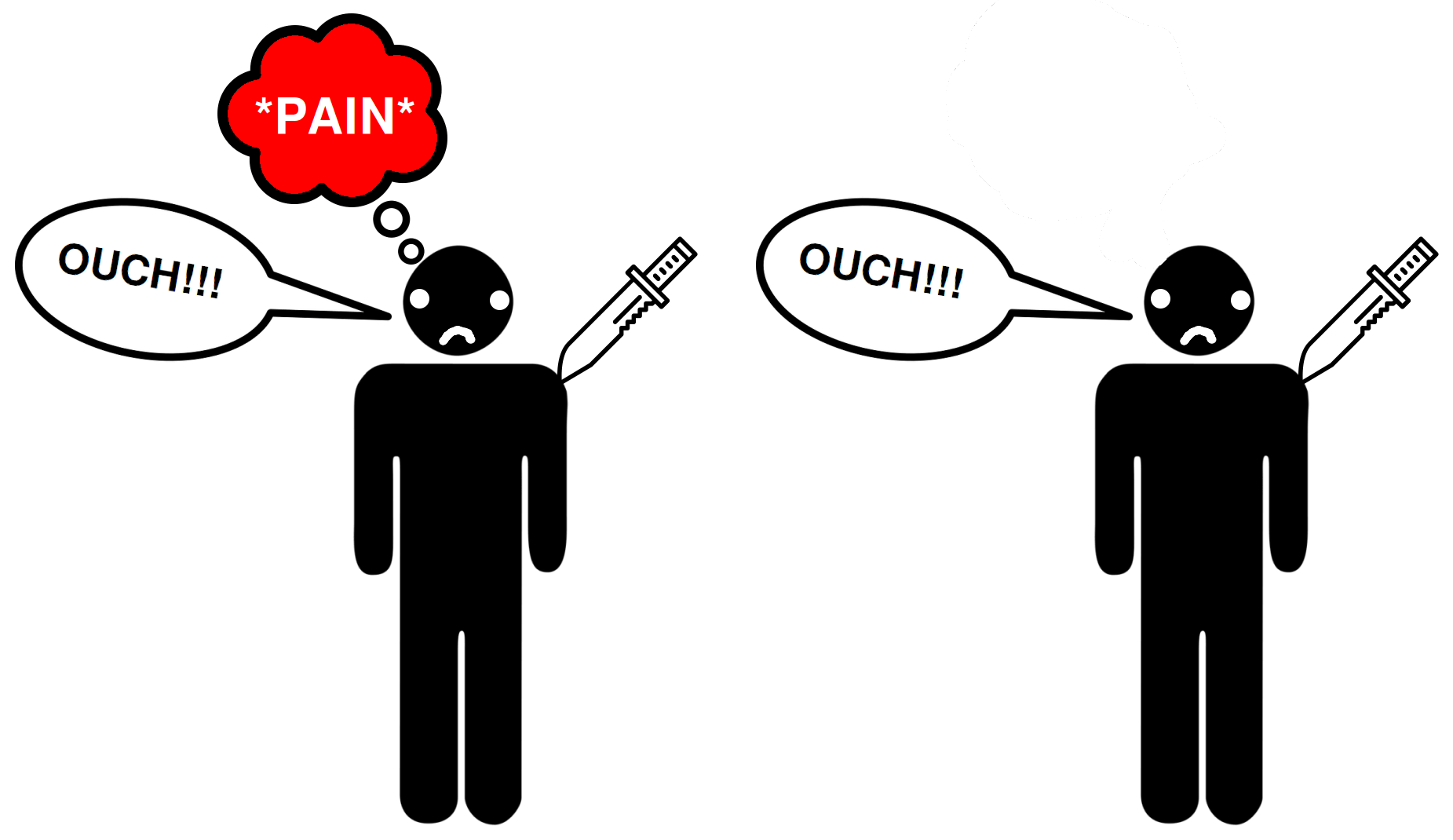
That’s the first step of the zombies argument: We can imagine such a being. You can imagine, for example, a physically identical version of you that don’t have consciousness.
And if we can imagine such a being, then such a being is possible – maybe not in this world, but in another possible world.
And if zombies are possible, then consciousness/qualia is non-physical.
“We can put the argument, in its simplest form, as follows:
(1) It is conceivable that there be zombies
(2) If it is conceivable that there be zombies, it is metaphysically possible that there be zombies.
(3) If it is metaphysically possible that there be zombies, then consciousness is non physical.
(4) Consciousness is nonphysical.”– David Chalmers, Consciousness and its Place in Nature
That’s the argument.
OK, but zombies couldn’t exist in the actual world
So you might be thinking the argument above is missing something.
Just because philosophical zombies are possible, it doesn’t follow that zombies could actually exist in reality. And so it doesn’t follow that consciousness is actually non-physical.
In other words, we might accept that – in some other possible world – zombies could exist. But we might also argue that – in our actual world – if something is physically identical, it would have the same qualia. So zombies aren’t physically possible in reality.
(In other words, step (3) of Chalmers’ argument as stated above is false).
Physics vs. metaphysics
But this response misunderstands the argument. It treats the debate as if it were a scientific question about what does exist, rather than a metaphysical question about what must exist.
Philosophy is different from science.
In science, you do actual experiments to work out the rules of our actual world. But, in philosophy, you do thought experiments to discover the rules of reality across possible worlds.
So, with that in mind, the zombies argument is a metaphysical argument. It attacks physicalism and supports property dualism – two more technical terms:
- Physicalism: Everything (including all properties) is either physical or supervenes on the physical.
- Property dualism: Some properties (i.e. qualia) are neither physical nor supervene on the physical.
If you want a further explanation of what ‘supervene’ means, see this page. But in short, if something supervenes on something else, it means that it can’t be separated from it – in any possible world.
Height, for example, supervenes on the physical because it’s not possible for something to be physically identical but have a different height. That just doesn’t make sense – if it’s physically identical, it will have the same height in every possible world. If something is taller or shorter, then it can’t be physically identical.
Physicalism says all properties work like this – height, length, shape, colour, beauty, and so on. And so, if something is physically identical, it is completely identical – it’s not possible for something to be physically identical but different in some way, in any possible universe.
But property dualism denies this. It says that you could – in another possible world – have something physically identical but different in some way. That physical facts don’t completely ‘fix’ everything. That some properties can – in theory – be separated from the physical.
This is where zombies come in.
Again, a zombie is physically identical to a regular human – same atoms, same brain, same behaviour – but that doesn’t have qualia. So, despite being physically identical, it’s different. The difference comes down to the qualia, and so qualia is non-physical. That’s the argument.
| Physicalism | Property dualism |
|---|---|
| Everything is either physical or supervenient on the physical. | Some mental properties (i.e. qualia) are neither physical or supervene on the physical. |
| So there is no possible world where something is physically identical but different in some way. | So there is a possible world where something is physically identical but with different properties (different/no qualia). |
| i.e. if physicalism is true, zombies would be metaphysically impossible. | i.e. if property dualism is true, then zombies are metaphysically possible. |
OK, but zombies are metaphysically impossible
The next response to the zombies argument tries to defeat it on its own, metaphysical, terms.
It argues that just because we can imagine something – just because it’s conceivable – it doesn’t follow that it’s metaphysically possible.
(In other words, it rejects step (2) of Chalmers’ argument as stated above).
 Another technical term: Metaphysical possibility.
If you want further detail on this term, check out this post. But in short, something is metaphysically possible if it could actually exist in some reality, and metaphysically impossible if its very nature or identity makes it impossible for it to exist, no matter how much we try to imagine it.
The classic example to illustrate this is water and H2O.
As we all know, water is H2O. That’s its identity. However, we can imagine a parallel universe where ‘water’ has a different chemical structure – XYZ, say.
In this imaginary world, XYZ fills the lakes, falls as rain, and tastes exactly like our water. This world is conceivable and logically possible. Unlike a ‘four-sided triangle’, which is a contradiction and therefore logically impossible, the concept of ‘water as XYZ’ doesn’t break the rules of logic. It makes sense as a thought and is conceivable.
But, despite being conceivable and logically possible, some Philosophers argue ‘water is XYZ’ isn’t metaphysically possible.
If water is H2O, then H2O is what water is – its essence.
So, the argument goes, there is no metaphysically possible world where water is XYZ, or H3O, or anything other than H2O. If you found a liquid that was XYZ – even if it looked exactly like water and behaved like water – it wouldn’t be water. It couldn’t be water. You cannot change the fundamental properties of a thing and still have that same thing. It’s not metaphysically possible.
Applying this to the zombies argument, a physicalist could argue that a ‘physical duplicate without qualia’ – i.e. a philosophical zombie – is like ‘water without H2O’. We can conceive of it (it’s a coherent thought that’s logically possible) – but it doesn’t follow that it’s metaphysically possible.
If physicalism is true, then consciousness and qualia are necessarily tied to physical brain processes in the same way water is tied to H2O. If you have the same physical processes, you must have the same consciousness.
On this view, if a being is truly, atom-for-atom physically identical to you, it would necessarily have your qualia. You couldn’t ‘strip away’ the qualia and leave the body behind any more than you could strip away the H2O and still be left with water.
Chalmers’ counter-reply
In response to the claim that conceivability does not entail metaphysical possibility above, Chalmers rejects the comparison of ‘physical without qualia’ to ‘water without H2O’:
“These difficulties stem from the fact that the character of the epistemic gap with consciousness seems to differ from that of epistemic gaps in other domains. For a start, there do not seem to be analogs of the epistemic arguments above in the cases of water, genes, and so on. To explain genes, we merely have to explain why systems function a certain way in transmitting hereditary characteristics; to explain water, we have to explain why a substance has a certain objective structure and behavior… Finally, it seems that we cannot coherently conceive of a world physically identical to our own, in which there is no water, or in which there are no genes. So there is no epistemic gap between the complete physical truth about the world and the truth about water and genes that is analogous to the epistemic gap with consciousness… So it seems that there is something unique about the case of consciousness.”
– David Chalmers, Consciousness and its Place in Nature
The reason the water analogy fails, according to Chalmers, is that it confuses how something looks with what something is.
When you look at a glass of water, it’s easy to imagine it’s made of something else – maybe a continuous fluid or a different molecule. That’s because there is a gap between the appearance (the clear, wet liquid) and the reality (the H2O molecules). Because of this gap, ‘water without H2O’ feels possible at first. But once you learn the deep physical facts, the illusion breaks down. You realise that the appearance is just a byproduct of the underlying chemistry. In reality, you can’t have the wet liquid without the H2O structure.
But with qualia, the appearance is the reality. The essence of qualia is how it feels, not its physical structure. The feeling of pain isn’t just a ‘surface appearance’ of some deeper hidden mechanism – the feeling itself is the phenomenon we are trying to explain. Unlike water, there’s no microscopic structure behind the feeling of pain or the feeling of a perception of a red tomato. There’s no deeper more fundamental layer to qualia like there is with water. Again, the essence of qualia is how it feels.
This leads to an epistemic difference in the two examples:
- With water: If you learned every physical fact about water, the gap between appearance and reality would vanish. You would see that water must be H2O.
- With the brain: If you learned every physical fact about a brain looking at a red tomato – every neuron firing and every chemical signal – there would still be a gap. You could know everything about the biology and still not know what it’s like for that person to see red (this is essentially the knowledge argument for property dualism).
So, in short, Chalmers insists that zombies are metaphysically possible.
Yes, conceivability doesn’t always entail metaphysical possibility. But, in the case of philosophical zombies, it does because qualia is intrinsic – to experience qualia is to understand its essential nature. And this essential nature can, conceivably and possibly, exist independently of the physical brain and the physical world.
No, zombies are not even conceivable
One final response is to argue that the entire zombie argument fails at the first hurdle – that zombies are not even conceivable.
(In other words, it rejects step (1) of Chalmers’ argument as stated above).
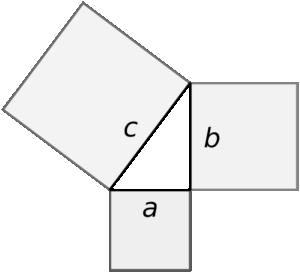
Physicalism can argue that the idea of a ‘physical duplicate without qualia’ – i.e. a philosophical zombie – is nonsense, inconceivable, unimaginable. It doesn’t make sense. Like a 4-sided triangle or, to use Descartes’ example, a triangle where the interior angles don’t add to 180°.
This is the position of, for example, philosophical behaviourism. To a behaviourist, ‘consciousness’ or ‘pain’ or ‘qualia’ isn’t some spooky internal feeling that only the person experiencing it can see. Instead, mental states are defined entirely by publicly observable behaviour or the disposition to behave in certain ways. ‘Being in pain’ just is the act of wincing, groaning, saying “ouch!”, etc. – there’s nothing more to pain than this.
So, for behaviourism, the word ‘pain’ is as inseparable from the physical states and behaviour as ‘3 sides’ is from ‘triangle’. The idea of a zombie who is physically and behaviourally identical to a human but lacks the internal experience is a logical contradiction, like a ‘4-sided triangle.’ And contradictions are inconceivable. If the zombie winces, cries out, and says “ouch!” then, by definition, it is in pain. It’s no more possible to imagine a philosophical zombie than it is to imagine a triangle with 4 sides.
A more modern (non-behaviourist) version of the ‘zombies are not conceivable’ response comes from Daniel Dennett, who argues that the idea of a philosophical zombie only seems coherent because we are confused about what consciousness is.
On this view, consciousness is not some extra inner thing (like qualia) over and above physical processes. Instead, it’s a complex and very detailed set of functional, cognitive, and informational processes. So, if a being was truly physically identical to a human would then it would process information in exactly the same way, form the same internal representations, make the same verbal reports about its experiences, and so on. And, on this view, once all these complex details and connections are fixed, there’s nothing left over for consciousness to be. There is no further thing that could be missing.
So, when we try to imagine a zombie – a being physically identical but lacking this missing thing (qualia) – we are not really imagining a coherent possibility. We are keeping all the physical and functional machinery of consciousness while subtracting something we cannot clearly specify. Dennett says is this is like trying to imagine:
- A perfect physical duplicate of a hurricane with all the same air movements, but without the storm
- A perfect physical duplicate of a fire, with all the same chemical reactions and heat output, but without any burning
- Or a system that does all the work of understanding, but without understanding
Such ideas are inconceivable – they don’t make sense. And Dennett says a philosophical zombie is similarly inconceivable. At best, we are imagining a verbal gap, not a real possibility. The zombie idea trades on the confused idea that consciousness is something over and above the physical/functional organisation of the brain.
The property dualist counter
The property dualist response to this is simple: No, zombies are conceivable.
And it’s hard to argue. It seems easy to – conceptually, in our imagination – separate the internal feeling of something with the external behaviours and the physical facts.
Against behaviourism, we can easily imagine a Super Spartan – a being capable of feeling pain but who never winces, says ouch, and so on. Or, the other way round: We can imagine a perfect actor who perfectly simulates the behaviours of pain but isn’t actually feeling pain inside. Even if such examples aren’t physically possible, they’re easily conceivable.
The very fact that we can even tell the difference between ‘faking pain’ and ‘actually feeling pain’ suggests that the feeling is something over and above the outward behaviours.
So property dualism would insist that qualia aren’t just behaviours. If you’re in pain, the wincing is a result of the pain, it’s not the pain itself.
The behaviourist tries to solve the problem by redefining consciousness to be something purely physical. But in doing so, they leave out the very thing we are trying to explain: the subjective experience, the qualia. If it’s possible to have the feeling without the movement (e.g. being paralysed but in pain), then it must be possible to have the movement without the feeling. And that gap is exactly what makes zombies conceivable.
And the same style of response can be extended to Dennett’s view too.
The property dualist would argue that Dennett’s analogies – the hurricane without the storm or the fire without the burning – fail because they involve ‘functional’ definitions. A hurricane is nothing more than the movement of air and water. A fire is nothing more than the chemical reaction of oxidation. Once you have the physical process, the thing is fully accounted for.
However, consciousness feels fundamentally different. We can describe every functional process in the brain – the firing of neurons, the processing of visual data, the triggering of a motor response – without ever mentioning the ‘what it’s like’ to see red or feel heat, without ever mentioning the qualia.
So property dualism can admit that while ‘hurricane without the storm’ is inconceivable, ‘brain process without the qualia’ is not. We can conceive of a system (e.g. a China Brain) that behaves exactly like someone seeing red – it identifies red objects, talks about red, remembers red, and reacts appropriately – but where there is no inner experience of redness at all.
This last point is closely related to Jackson’s knowledge argument – another famous argument for property dualism. With both arguments, the claim is the same: It seems conceivable that you can fix all the physical and functional facts but still leave something out – the ‘what it’s like’ of experience, the qualia.
Summary
- Physicalism is the metaphysical view that everything is either physical or supervenes on the physical.
- In other words, it says that if something is physically identical, there is no possible world where it could be different in some way (e.g. different properties).
- But property dualism denies physicalism and says qualia/consciousness is neither physical nor supervenes on the physical.
- The zombies argument supports property dualism because it describes a seemingly possible world that is physically identical but different: A world where humans are physically identical but lack qualia/consciousness.
- If zombies are possible, then physicalism is false because qualia ‘comes apart’ from the physical. The physical facts alone don’t necessarily ‘fix’ the qualia.
- The zombies argument supports property dualism because it describes a seemingly possible world that is physically identical but different: A world where humans are physically identical but lack qualia/consciousness.