
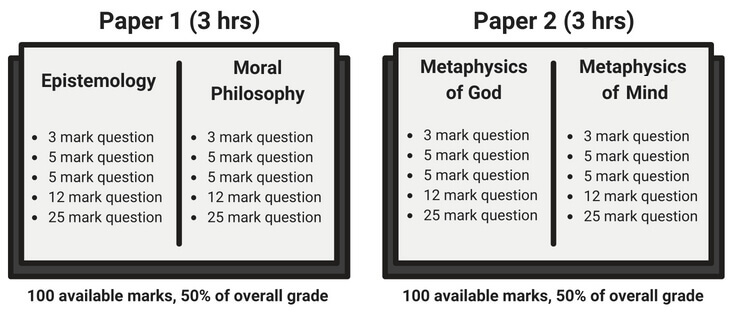
Whereas the other questions (3, 5, and 12 marks) require you to explain an idea or argument (AO1), the 25 mark essay questions require you to argue for and evaluate a particular philosophical viewpoint (AO2). In other words, you have to take a stance on a topic and argue that it is the correct one. Below are 5 tips to help achieve the top grade boundary with your 25 mark philosophy essays.
(Note: Although these tips are specifically targeted for AQA A level philosophy, most apply to philosophy essay writing in general).
1. A consistent argument
Your essay must argue consistently for a particular viewpoint.
For example, if you get a question on Berkeley’s idealism, you would argue either:
- That idealism is the correct theory of perception
- Or that idealism isn’t the correct theory of perception
Or, depending on the question, you might argue for a more nuanced position. For example, if you get a question on cosmological arguments there are more than just 2 options, such as:
- That cosmological arguments do succeed in proving God exists
- That cosmological arguments do not succeed in proving God exists
- That although cosmological arguments from causation fail to prove God exists, cosmological arguments from contingency do succeed in proving God exists
Or, if you get a question on utilitarianism, you might choose one of the following positions to defend:
- That utilitarianism is the correct account of morality
- That utilitarianism is not the correct account of morality
- That although hedonistic act utilitarianism is flawed, preference utilitarianism provides the correct account of morality
Whatever position you pick, the arguments that follow must ultimately support this. Explain which side you are arguing for in both introduction and conclusion.
2. A balanced argument
Even though you are arguing for one side, you can’t ignore issues for that side – you must present objections (in their strongest form) and then respond to them.
For example, if you are arguing against Berkeley’s idealism, you could:
- Start with the solipsism objection
- Consider Berkeley’s response that God is constantly perceiving everything
- Then respond to that by pointing out issues with the role of God in Berkeley’s idealism.
- Consider Berkeley’s response that God is constantly perceiving everything
The kind of ‘argument sandwich’ structure above – objection, response, counter-response – is a good blueprint to bear in mind when writing your essays. Notice that this structure maintains the original point (i.e. that idealism is wrong) but defends it against how Berkeley might respond.
However, just because you are arguing for a particular viewpoint, that doesn’t mean you have to say every argument in support of that viewpoint is successful.
For example, if you are arguing against utilitarianism you could:
- Start with the difficulties with calculation objection to utilitarianism
- Move on to a different objection (e.g. the tyranny of the majority) and start your paragraph with “However, a stronger argument against utilitarianism is…”
Or if you are arguing against property dualism you could:
- Start with the zombie argument for property dualism
- Consider the response that just because zombies are conceivable that doesn’t mean they are physically possible
- Reject this response as a weak response because it misunderstands the property dualist’s claim
- Move on to the stronger objection that just because zombies are conceivable that doesn’t mean they are metaphysically possible
- Consider the response that just because zombies are conceivable that doesn’t mean they are physically possible
The point with these examples is that your side ultimately wins (so your essay is consistent) but by balancing the various arguments and responses and evaluating them you are demonstrating why your side is better than the other side.
3. Paragraph structure
Make one point per paragraph – don’t mix multiple arguments into the same paragraph.
For example, the veil of perception problem for indirect realism would be one paragraph, then Russell’s response that the external world is the best hypothesis would be a separate paragraph.
As a general rule, the PEEL structure (point, evidence (or example), explanation, link) works quite well for paragraphs – always have an extra sentence at the end of each paragraph that explains what the argument shows and relates it to the question.
For example, here is how you might make the argument that the infallibilist definition of knowledge is too strict:
- Point: The infallibilist definition of knowledge is too strict.
- Evidence/example: Infallibilist definitions of knowledge say that knowledge is true belief that must be justified in such a way that it is certain and impossible to doubt. However, there are many instances of beliefs that qualify as ‘knowledge’ that are not certain. For example, my belief that “Paris is the capital of France” could be false – I may be being deceived by an evil demon, or have been lied to all my life, or I could be hallucinating, and so on – and so these possible reasons for doubt mean my belief that “Paris is the capital of France” does not count as knowledge according to infallibilism.
- Explanation: However, these scenarios are not realistic reasons to doubt the belief that “Paris is the capital of France”. Even though I can’t be 100% certain of this belief, it is still clearly an example of knowledge, and yet infallibilism would say it is not an example of knowledge. This shows that the infallibilist definition of knowledge is too strict.
- Link: The correct definition of ‘knowledge’ must provide necessary and sufficient conditions for the term. But this example shows that certainty/the impossibility of doubt is not necessary for knowledge, and thus the infallibilist definition of knowledge fails.
4. Detailed arguments (depth>breadth)
It’s better to cover a few arguments in detail rather than simply listing all the arguments you know without analysing them in any real depth.
For example, there are too many bullet points on the specification for cosmological arguments to develop them all in detail for a 25 mark essay:

You don’t have to cover every possible argument for or against a theory – that’s not even possible. Instead, two or three arguments (and responses) is more than enough to achieve the top grade boundary if handled correctly.
5. Time management
Plan out your essays in advance and memorise the general structure (this is the single most effective revision technique IMO).
This might sound like a lot of work, but there are only around 20 or so major topics that you can get asked 25 mark questions on. It’s difficult enough to remember all these arguments – let alone integrate them into a consistent and balanced essay within the 45 mins or so you’ll have in the exam!
By memorising the structure of your essay in advance, you can save time that would be spent planning your essay.
Also, don’t spend ages describing theories etc. because that is AO1/knowledge and in the 25 mark essay questions only 5/25 (20%) marks are available for AO1. Instead, just quickly define any key terms then move on to the evaluation/arguments (AO2), because 20/25 (80%) marks are awarded for AO2.
25 mark essay blueprint
Bringing all the points above together, your overall essay structure might look something like this, where each line is its own paragraph:
- Intro (quickly define key terms and say which side you are arguing for)
- Argument in support of your position
- Potential response
- Counter-response defending your position
- Another potential response (you can perhaps do some weighing up here like “a stronger response is…”)
- Counter-response defending your position
- Potential response
- Argument against your position
- Response defending your position against this attack
- Conclusion (my side is correct because of the arguments above)
The point is the essay is consistent overall (the green side wins) but also balanced (it considers the points in red and evaluates/responds to them).
 For more detail, the How to Get an A in A-Level Philosophy textbook contains consistent and balanced example essay plans for every major topic as well as further detail on how to structure your 25 mark philosophy essays to achieve the top grade boundary in the exam.